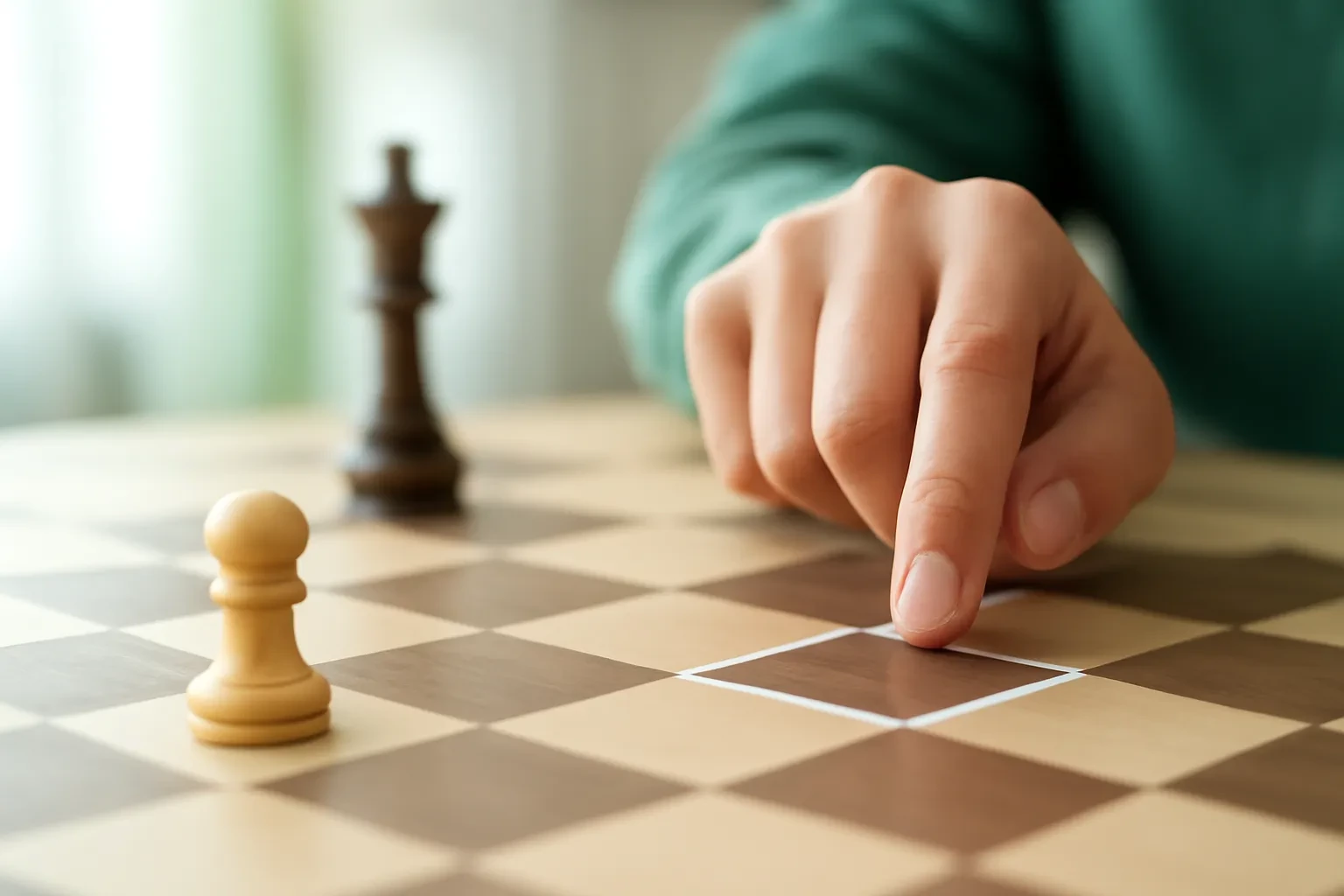
In king and pawn endgames, the most common question is also the most decisive: can the king catch the pawn? If it can, the game is usually drawn or even lost for the side with the pawn. If it can't, the pawn becomes a queen and the game is over.
You could count every move. But there's a shortcut that takes about two seconds and almost never lets you down: the rule of the square.
How to draw the square
For a passed pawn — one with no enemy pawns in front of it or on adjacent files:
- Take the path from the pawn to its promotion square, counting the square the pawn is on.
- Use that path as one side of a square on the board, extending toward the defending king.
- If the defending king is inside the square, or can step into it on its move, it catches the pawn. If not, the pawn promotes.
The side to move is everything
Now take the same position with White to move. White plays b6 first, and the square shrinks to b6–b8–d8–d6. The king on f4 can't reach any square of the new, smaller square in one move. The pawn promotes and White wins. We checked both versions with an engine: Black to move draws; White to move wins.
The practical lesson: always draw the square for the side whose turn it is. If the pawn moves first, shift the square one rank forward before checking where the king is.
The starting-rank exception
A pawn on its starting rank can move two squares at once. So for a white pawn on the 2nd rank (or a black pawn on the 7th), draw the square as if the pawn were already one rank further forward.
Why it's a square
A king moves one square per turn in any direction, including diagonally. Because a diagonal step costs exactly the same as a straight one, the set of squares a king can reach in a given number of moves is always a square around it — not a circle or a diamond. A pawn only moves straight ahead. The rule of the square is simply the point where those two shapes meet.
Understanding this makes the rule easier to trust — and it's the key to the most famous study in endgame history.
The Réti study
At first glance, White is hopelessly lost. The h-pawn will run, and White's king is far outside its square. But because diagonal moves cost no extra time, the king can walk toward two goals at once: the square of Black's pawn and the support of White's own c-pawn.
Black has to choose. If Black's king goes after the c6 pawn, White's king steps into the square of the h-pawn. If Black pushes the h-pawn, White's king supports c6–c7–c8 and both sides promote. Either way, it's a draw.
The lesson goes beyond the rule of the square: a single king move can serve two purposes. In pawn endings, always look for such moves first.
When the rule needs care
The rule of the square assumes it's just a king chasing a pawn. In real games, watch out for:
- Obstacles. If a pawn or piece blocks the king's route, it may have to take a detour and arrive too late, even from inside the square.
- The attacking king. If the pawn's own king is nearby, it can shoulder the defending king away or escort the pawn. That's where opposition comes in.
- Checks. Promoting with check, or a defending king that gets checked on the way, changes the count.
- Two passed pawns. A king can stand in the square of one pawn but not both at once — which is exactly why an outside passed pawn is so strong.
Two passed pawns
If one side has two passed pawns far apart, the defending king usually can't handle both: standing inside the square of one leaves it outside the square of the other. This is why an outside passed pawn is such a big asset in pawn endgames — it drags the enemy king to one side while your king feasts on the other.
Connected passed pawns (side by side) often protect each other: if the king captures the rear pawn, the front one runs. And two pawns separated by one file can sometimes defend each other in a similar way.
Using the rule in real games
The rule's biggest practical value is in deciding whether to trade into a pawn endgame:
- If, after the trades, you'll have a passed pawn whose square the enemy king can't reach, trade immediately — it's a win.
- If the enemy king is inside the square, calculate further. Can you create a second passed pawn on the other wing?
Club players miss wins all the time by avoiding trades out of caution, and just as often trade into "winning" pawn endgames that turn out to be draws. A two-second square check prevents both.
A quick self-test
Before you move on, try this in your head: a white pawn on g4, the white king far away on a1, the black king on c5, Black to move. The pawn needs four squares to reach g8, so the square runs g4–g8–c8–c4. The king on c5 is already inside, so it catches the pawn. Now give White the move instead: after g5, the square becomes g5–g8–d8–d5, and the king on c5 can step to d5 or d6 to get in. Still a draw — we checked both with an engine. (Move the white king to h1, though, and with White to move the king escorts its pawn home: the rule of the square only covers a pure race.)
Practice
- Use the play links under each diagram to try both sides to move against the engine.
- Make your own quizzes. Put a pawn on any file and the enemy king on any square, guess the result in three seconds, then check by playing it out.
- Move on to opposition. The rule of the square handles the race; opposition handles the fight between kings. Together they cover most pawn endings. More in our endgames section.
Frequently asked questions
Does the rule work for Black's pawns too?
Yes, exactly the same way — the square just points toward the first rank. A black pawn on the 7th rank is treated as if it were on the 6th.
Does the king count as inside if it's on the edge of the square?
Yes. Any square on the border or corner of the square counts as inside.
What if there are other pieces on the board?
Then the rule is only a starting point. Other pieces can block the king, give checks, or protect the pawn, so you need to calculate concretely.
What does the Réti study teach?
That a king moving diagonally loses no time, and that one king move can pursue two goals at once. In pawn endgames, look for those dual-purpose moves first.
Do I still need to count moves?
For a simple king-versus-pawn race, the square is enough. With more pawns or pieces, it's worth counting concretely to be sure.