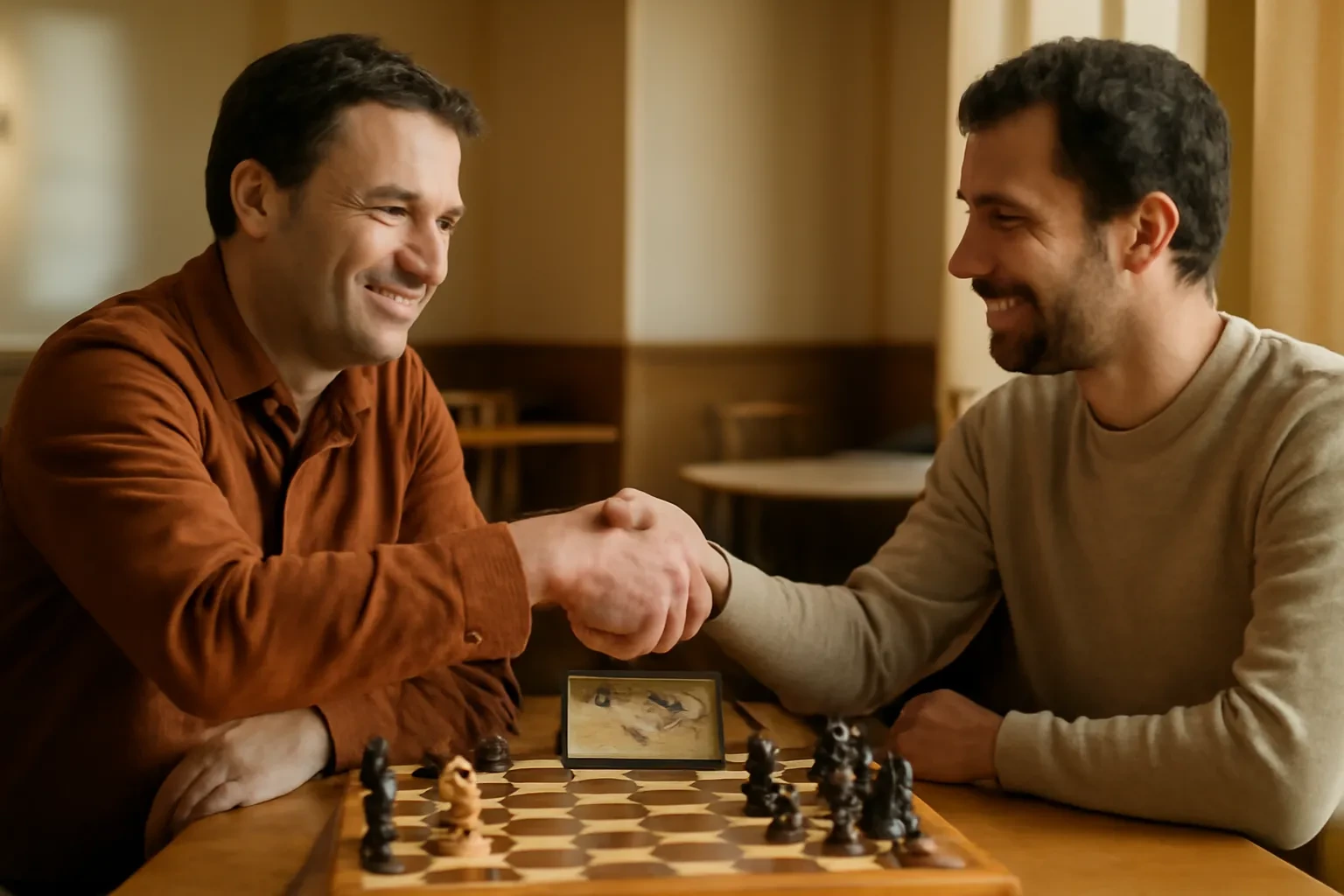
Most beginners learn how to win a chess game long before they learn all the ways it can be drawn. That's a problem, because draws aren't just what happens when nobody wins — they are rules you can use. A player who is losing can save the game with a well-timed stalemate or repetition. A player who is winning can throw it all away by not knowing them.
Here are the five main ways a chess game ends in a draw, what each one really means, and how to use them from both sides of the board.
1. Stalemate
Stalemate happens when the player to move has no legal moves and is not in check. The game ends immediately in a draw.
Stalemate is the most common way to throw away a won game. It usually happens when a player with a big material advantage "squeezes" the enemy king without checking it. The fix is simple: when your opponent has only a king (or a king and pieces that can't move), before every move, make sure they'll still have a legal move afterwards, unless your move is checkmate. See stalemate vs checkmate for more examples.
2. Threefold repetition
If the same position occurs three times, with the same player to move and the same possible moves (including castling and en passant rights), either player can claim a draw. The repetitions don't have to be consecutive.
The most common version is perpetual check: one side keeps checking the enemy king, and the king can't escape the checks. The position repeats and the game is drawn.
Online, repetition is detected and applied automatically. Over the board, you usually need to claim it — typically by stopping the clock and calling the arbiter, often before making the move that would repeat the position for the third time. Local tournament rules explain the exact procedure; if in doubt, ask the arbiter.
3. The fifty-move rule
If fifty consecutive moves by each player pass without any pawn move and without any capture, a draw can be claimed.
The rule exists to stop games dragging on forever in positions where nobody can make progress. It matters in some endgames where the winning side needs many moves — for example, king, bishop and knight against a lone king, which can take more than thirty moves even with perfect technique.
Under current tournament rules, a position that reaches seventy-five moves without a pawn move or capture is drawn automatically, even if nobody claims it.
4. Insufficient material
The game is drawn immediately when neither side can possibly checkmate with the pieces left on the board. The classic cases:
- King against king.
- King and bishop against king.
- King and knight against king.
- King and bishop against king and bishop, with the bishops on the same color.
Note that king and two knights against a lone king is not automatically drawn — checkmate is possible in some positions, even though it can't be forced. And a player who runs out of time is not automatically losing if the opponent has insufficient material to ever checkmate — in many rule sets, that's a draw too.
5. Draw by agreement
Players can simply agree to a draw. Over the board, one player offers a draw — ideally right after making a move and before pressing the clock — and the opponent accepts or declines.
A few etiquette points:
- Don't offer repeatedly. Offering a draw again and again can count as distracting your opponent.
- Make your move first, then offer. Offering on your opponent's time is disruptive.
- Some tournaments ban early draw offers (for example, before a certain move number) to encourage fighting chess.
Dead positions
Beyond the classic cases of insufficient material, the rules also recognise dead positions: positions where neither side can checkmate by any sequence of legal moves, even with extra pieces on the board. A common example is a completely locked pawn chain where neither king can ever get through and no other pieces remain. The game ends in a draw as soon as such a position arises. In practice, most club players will simply agree a draw in these positions, but it's useful to know the rule exists.
Draws in online chess
Online platforms apply these rules automatically: stalemate, threefold repetition, the fifty-move rule and insufficient material all end the game without anyone needing to claim. Some platforms also let you offer and accept draws with a button, and many block draw offers in the first few moves. If you mostly play online, the main thing to remember is simply that the rules exist — especially stalemate and repetition, which can save or throw away a game in seconds.
Using draw rules when you're losing
A worse position isn't always a lost one. Look for:
- Stalemate tricks. If you have only your king and a few pawns that can't move, see whether your opponent can be tempted into taking away your last legal move.
- Perpetual check. If your queen or rook can keep checking the enemy king with no escape, you can force a draw even far behind in material.
- Fortress positions. Some endgames can't be won even with extra material, such as many opposite-colored bishop endings. Steering toward them can save the game.
Avoiding draws when you're winning
- Check for stalemate before every move in the endgame.
- Avoid giving your opponent perpetual check — keep your king sheltered while you convert.
- Watch the fifty-move count in long technical endgames.
- Keep enough material to mate. Trading down to king and bishop against king is a draw no matter how "winning" it looked.
Practicing
The board on our play page applies all of these rules automatically, including stalemate, repetition and insufficient material. Try playing out the stalemate diagram above against the engine using the link under it, and practise the basic king and rook checkmate until you can do it without ever stalemating. More in the rules section.
Frequently asked questions
Is stalemate a win for the side that stalemates?
No. Stalemate is always a draw, regardless of material.
Do repetitions have to be consecutive?
No. The same position must occur three times, with the same side to move and the same possible moves, but not necessarily in a row.
Can I win on time if my opponent has only a king?
Usually not. If you have insufficient material to ever checkmate, running your opponent out of time typically results in a draw rather than a win. Check your platform's or event's rules.
What is perpetual check?
A sequence of checks the defending king can't escape. It leads to repetition and a draw.
When should I offer a draw?
After making your move, when you honestly think the position is balanced or you're worse. Avoid repeated offers.