When you're new to chess, it's hard to know how to spend your time. Should you play as many games as possible? Study openings? Watch videos? Solve puzzles? The honest answer is that beginners improve fastest with a simple, balanced routine that mixes playing, tactics, a little endgame work, and reviewing their own games.
This article gives a weekly routine for beginners, explains why each part matters, and lists signs that you're on track. If you haven't learned the rules yet, start with chess rules for beginners. For a more detailed first month, see first month chess plan.
The four parts of practice
1. Playing slow games
Games are where everything comes together. For beginners, slower is better: 15 minutes per side with a small increment, or even untimed games against the engine. Slow games give you time to check threats, count attackers, and think, which builds the habits you need.
2. Tactics puzzles
Most beginner games are decided by tactics: a hanging piece, a fork, a back-rank mate. Daily puzzles train you to see these patterns. See how to solve puzzles.
3. Basic endgames
Knowing how to checkmate with a queen or a rook, and understanding a few pawn endgame ideas, turns winning positions into actual wins. See king and rook checkmate and endgame principles.
4. Reviewing your games
Looking back at your own games, especially losses, shows you exactly what to fix. Even five minutes per game helps. See how to analyze your games.
A weekly routine
Here's a routine for about 20–30 minutes a day, five or six days a week:
| Day | Activity | Time |
|---|---|---|
| Monday | Tactics puzzles + one slow game | 25 min |
| Tuesday | Tactics puzzles + basic endgame practice | 20 min |
| Wednesday | One slow game + review it | 30 min |
| Thursday | Tactics puzzles + review a previous game | 20 min |
| Friday | One slow game, for fun | 20 min |
| Weekend | Longer game with a friend or club, or rest | Flexible |
Adjust to your schedule. The key is consistency and balance, not the exact minutes.
What not to do yet
- Don't memorize long opening lines. Follow basic principles: control the center, develop knights and bishops, castle early. See opening principles.
- Don't play mostly bullet or blitz. Fast games are fun but make it hard to build good habits.
- Don't jump between too many resources. Pick one puzzle source, one way to play, and stick with them for a while.
Building the "blunder check" habit
The single most useful habit for beginners is a quick check before each move:
- What did my opponent's last move threaten?
- Are any of my pieces undefended or attacked?
- After my move, can anything be captured for free?
In slow games, do this every move. It feels slow at first, but within a few weeks it becomes automatic. See common beginner mistakes.
Playing with people and engines
- Engines are always available and let you choose the difficulty. The play page has several levels; pick one where you win about a third to half of your games.
- People give you real opponents with human mistakes and real psychology. Play friends, family, a local club, or online opponents near your level. See playing friends online.
A mix of both works best.
Signs you're on track
After a month or two of consistent practice, you should notice:
- Fewer pieces lost for nothing.
- You see simple forks and pins in your games, not just in puzzles.
- You can checkmate with king and queen without stalemating.
- Your games last longer before the decisive mistake.
- You understand why you lost most games.
If you're not seeing these, look at your routine: are you playing too fast? Skipping review? Solving puzzles by guessing?
Keeping motivation
- Track small wins: first checkmate with a rook, first week without hanging a queen.
- Play for fun sometimes, without worrying about improvement.
- Find a chess friend to share progress with.
- Remember that progress isn't linear. Plateaus are normal.
Common mistakes
Only playing, never reviewing. Repeats the same mistakes.
Only studying, never playing. Knowledge that isn't tested in games doesn't stick.
Playing too fast. Skips the thinking habits you need.
Chasing openings. Tactics matter far more at this stage.
Giving up after a bad week. Everyone has them.
A closer look at a practice session
Here's what a single 25-minute session might look like in practice:
- Five minutes of warm-up puzzles: easy ones, to get your eye in.
- Fifteen minutes playing a slow game, or part of one, using the blunder check on every move.
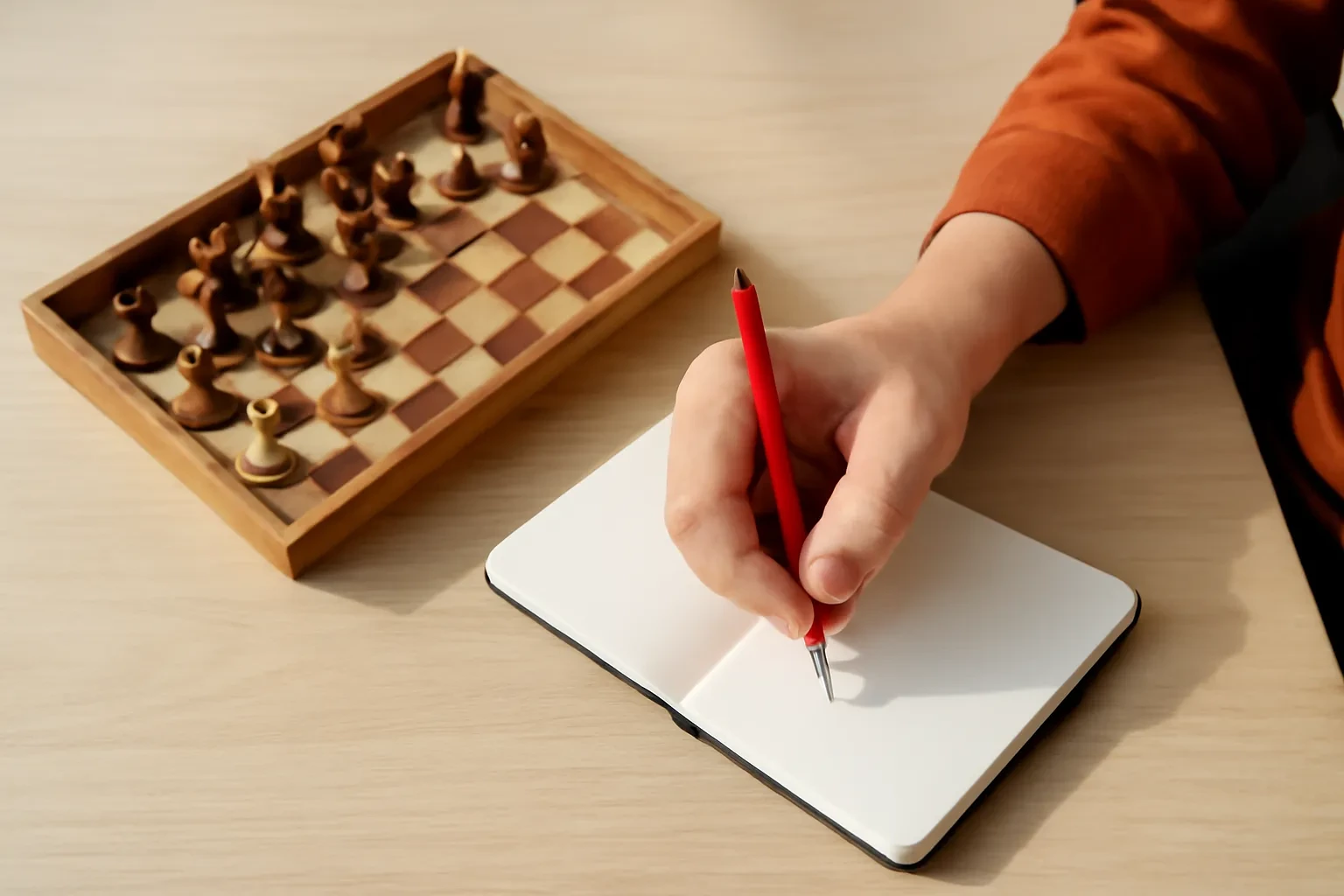
- Five minutes of review: find the moment where you lost material or missed a chance, and write one sentence about it.
Short sessions like this add up. After a month, that's over a dozen reviewed games and hundreds of puzzles, which is more real practice than most beginners get in a year of random play.
Learning the endgame basics early
Many beginners postpone endgames because they seem boring. But a few basic endgames pay off immediately:
- King and queen vs. king: so you never fail to win with an extra queen.
- King and rook vs. king: the same idea with a rook, a bit harder.
- King and pawn vs. king: understand when the pawn promotes and when it's a draw.
Each takes only a few sessions to learn and will save you many half-points.
Getting help
If you get stuck, don't hesitate to ask. A local club, a stronger friend, or a short lesson can clear up confusion quickly. Bring a specific game or question; it makes the help much more useful.
Frequently asked questions
How much should a beginner practice each day?
About 20–30 minutes, most days of the week, is enough to improve steadily.
Should beginners study openings?
Only basic principles. Tactics and simple endgames matter much more at first.
What time control should beginners play?
Slower games, like 15 minutes per side with increment, or untimed games against the engine.
Is it better to play people or engines?
A mix of both. Engines are convenient and adjustable; people give real practice.
How do I know I'm improving?
You'll lose fewer pieces for nothing, spot tactics in your games, and understand why you lost. More beginner guides are in the beginners section.
How long until I see results?
Most beginners who practice consistently for 20–30 minutes a day notice fewer blunders within a few weeks. Bigger changes, like understanding plans and winning endgames reliably, usually take a few months of steady work.