Chess looks complicated at first: six different pieces, special moves with French names, and a set of ways to draw that even experienced players occasionally forget. But the core rules fit on a single page, and most people can play a complete, legal game within an afternoon of learning.
This guide collects every rule a beginner needs in one place: how to set up the board, how each piece moves, the three special moves, what check and checkmate mean, and every way a game can end. When you are ready to play, the play page lets you practice against the engine at a gentle level.
The board
- The board has 64 squares in an 8×8 grid, alternating light and dark.
- Place it so each player has a light square in the bottom-right corner. A common reminder: "light on the right."
- Columns are called files and labeled a to h from White's left. Rows are called ranks and numbered 1 to 8 from White's side.
- Every square has a name: the file letter plus the rank number, for example e4. See how to read chess notation.
Setting up the pieces
From White's side, the back rank (rank 1) reads from left to right:
Rook, Knight, Bishop, Queen, King, Bishop, Knight, Rook.
- The queen goes on her own color: the white queen on the light square d1, the black queen on the dark square d8.
- The pawns fill the second rank for White and the seventh rank for Black.
- The kings face each other on the e-file.
White always moves first. Then players alternate, one move each.
How the pieces move
| Piece | Movement | Captures |
|---|---|---|
| King | One square in any direction | Same as movement |
| Queen | Any number of squares in any straight line or diagonal | Same |
| Rook | Any number of squares along a rank or file | Same |
| Bishop | Any number of squares diagonally | Same |
| Knight | In an "L": two squares one way, then one square at a right angle; jumps over pieces | Same |
| Pawn | Forward one square (two from its starting square) | One square diagonally forward |
Important details:
- Only the knight can jump over pieces. Every other piece is blocked by anything in its way.
- Pawns never move backward and capture differently from how they move.
- You capture by moving onto the square of an enemy piece and removing it. You can never capture your own pieces.
- A king can never move into check, meaning onto a square where it could be captured.
For a sense of how much each piece is worth when trading, see chess piece values.
The three special moves
Castling
Castling moves the king two squares toward a rook, and the rook jumps to the square the king crossed. It is the only move where two pieces move at once. You may castle only if:
- Neither the king nor that rook has moved yet.
- No pieces stand between them.
- The king is not in check, does not pass through a square under attack, and does not land in check.
Details and common misunderstandings are in castling rules.
En passant
If a pawn moves two squares from its starting position and lands right beside an enemy pawn, that enemy pawn may capture it as if it had moved only one square. The capture must be made immediately on the next move, or the right is lost. See en passant explained.
Promotion
When a pawn reaches the far rank, it must be promoted to a queen, rook, bishop, or knight of the same color. Almost always players choose a queen, but occasionally a knight or rook is better. You can have more than one queen.
Check, checkmate, and stalemate
- Check: the king is attacked. The player in check must get out of it immediately, by moving the king, capturing the attacker, or blocking the attack.
- Checkmate: the king is in check and there is no legal way out. The game is over and the side giving checkmate wins.
- Stalemate: the player to move is not in check but has no legal moves. The game is a draw.
Beginners who are winning often stalemate by accident. Before each move in a winning endgame, check that your opponent still has a legal move. See stalemate vs checkmate.
How a game ends
A win comes from:
- Checkmate.
- The opponent resigning.
- The opponent running out of time on the clock, if you still have enough material to possibly checkmate.
A draw comes from:
- Stalemate.
- Agreement between the players.
- The same position occurring three times with the same player to move.
- Fifty moves by each side with no capture and no pawn move.
- Neither side having enough material to checkmate, for example king versus king, or king and bishop versus king.
For details, see draw rules in chess.
Etiquette and practical rules
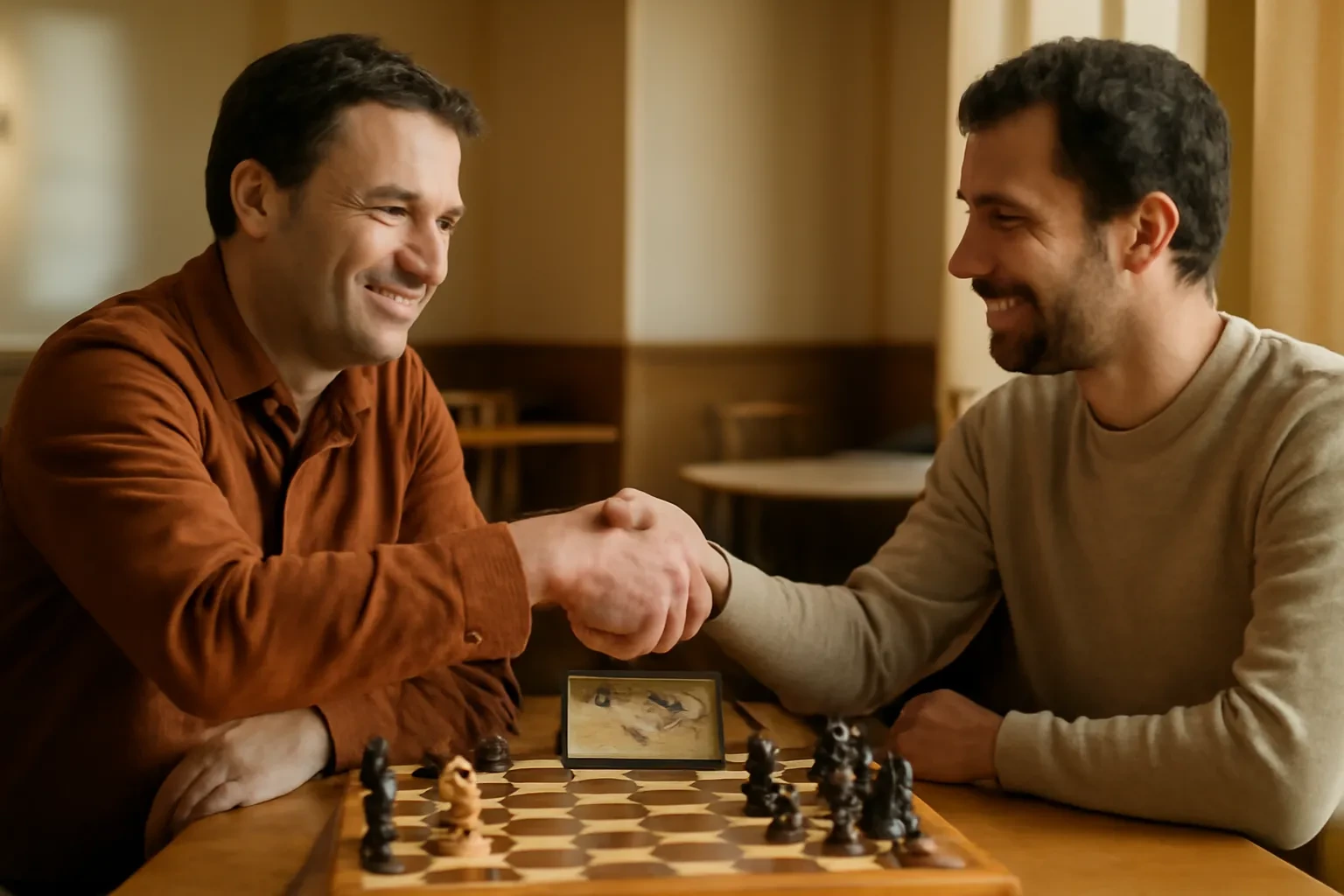
In casual games, friends often allow take-backs. In clubs and tournaments, the touch-move rule applies: if you deliberately touch one of your pieces, you must move it. Shaking hands before and after the game is standard. See touch-move and etiquette.
A learning order that works
- Set up the board correctly and learn the names of the pieces.
- Learn how each piece moves, one at a time.
- Practice capturing with simple games, such as pawns only.
- Learn check and checkmate.
- Add castling, promotion, and en passant.
- Play full games, slowly.
Then move on to how to start playing chess and your first month plan.
Common beginner rule mistakes
Putting the board the wrong way round. Light square on the right.
Swapping king and queen. The queen goes on her own color.
Moving pawns diagonally without capturing. Pawns move straight but capture diagonally.
Castling through check. Not allowed.
Leaving the king in check. Illegal; you must deal with the check.
Thinking stalemate is a win. It is a draw.
Frequently asked questions
Who moves first in chess?
White always moves first.
Can a pawn move backward?
No. Pawns only move forward, and they capture diagonally forward.
Can I castle if my king was in check earlier?
Yes, as long as the king is not in check at the moment you castle and neither the king nor that rook has moved.
Is stalemate a win?
No. Stalemate is a draw.
What happens when a pawn reaches the last rank?
It must be promoted to a queen, rook, bishop, or knight. More basics are in the rules section.