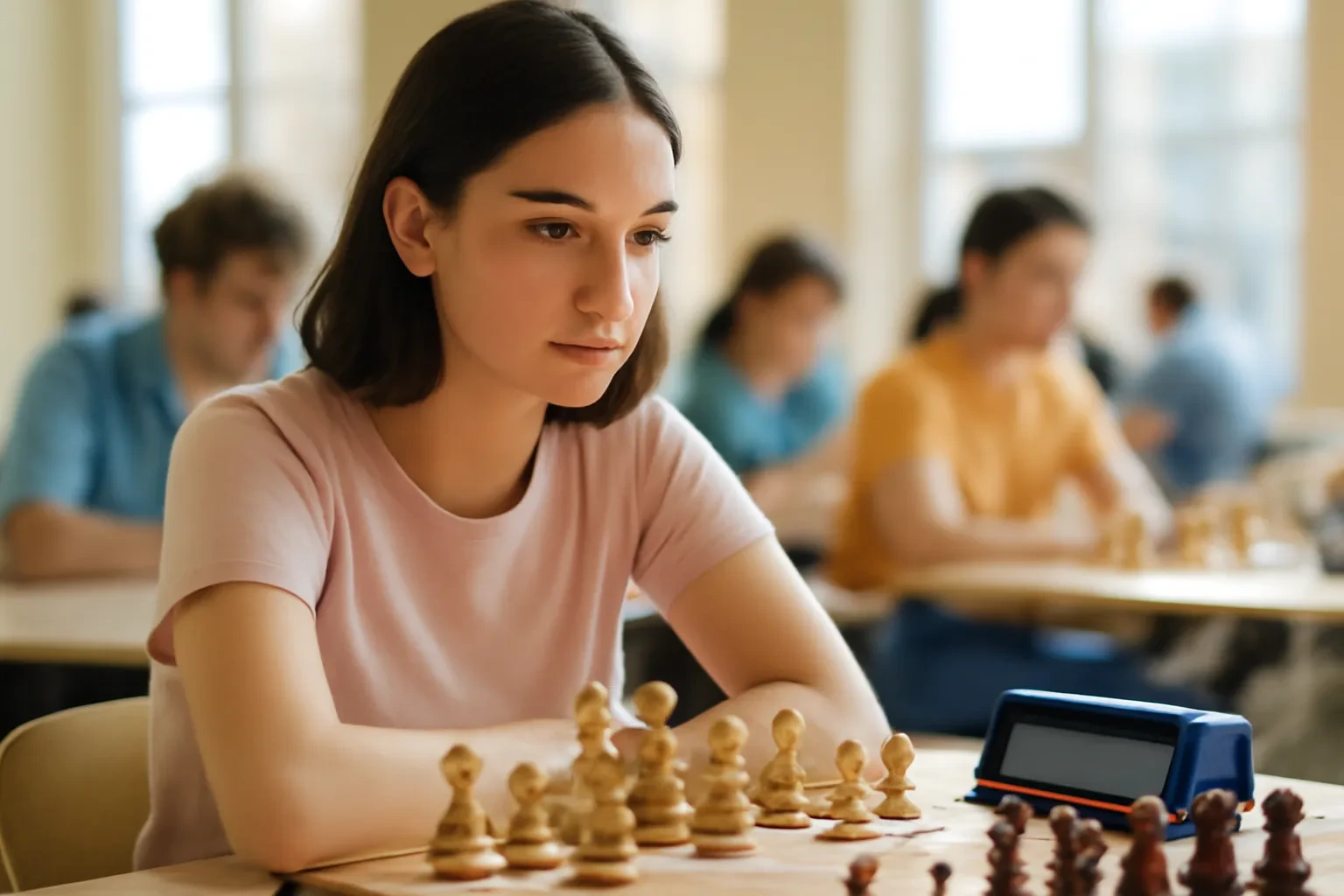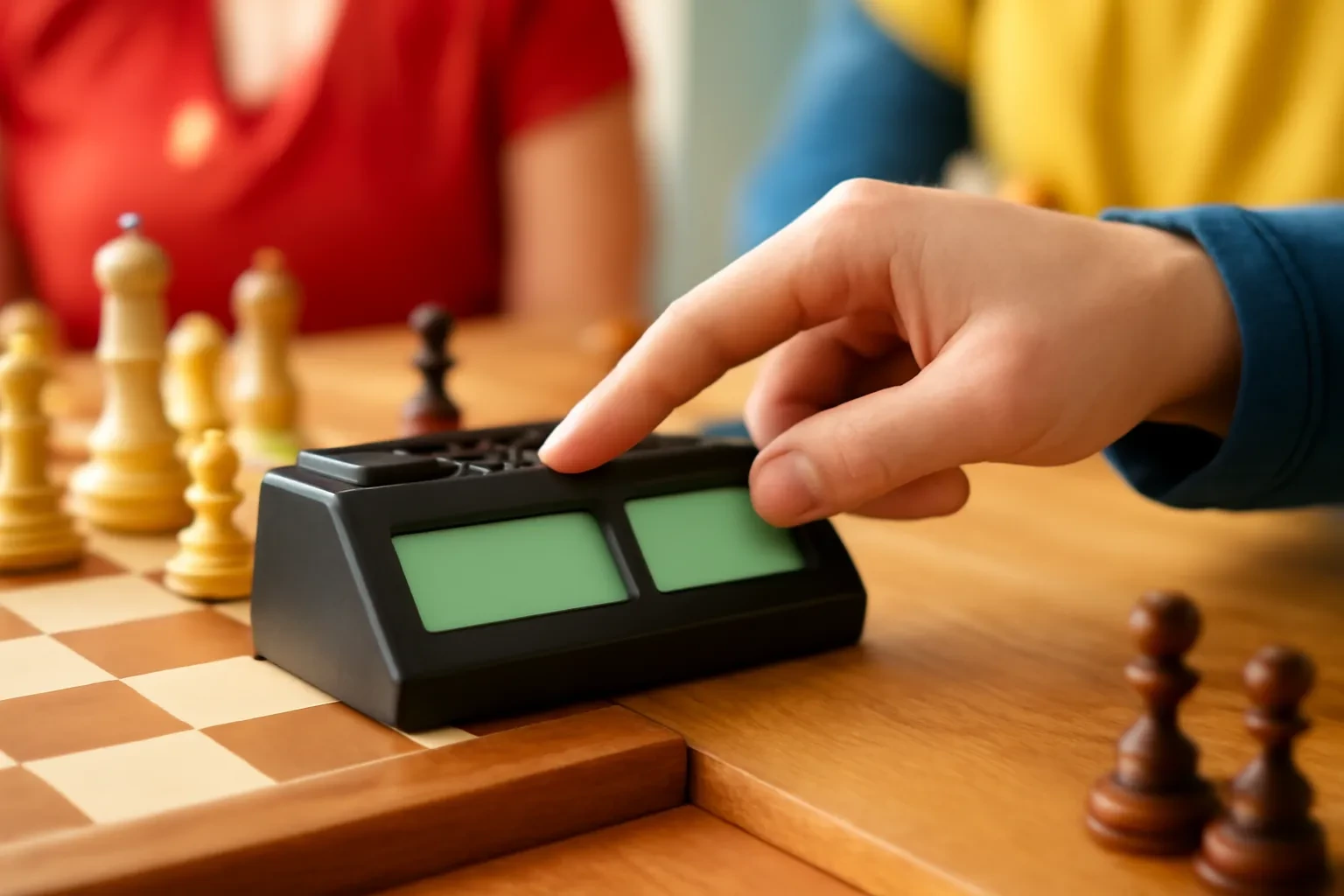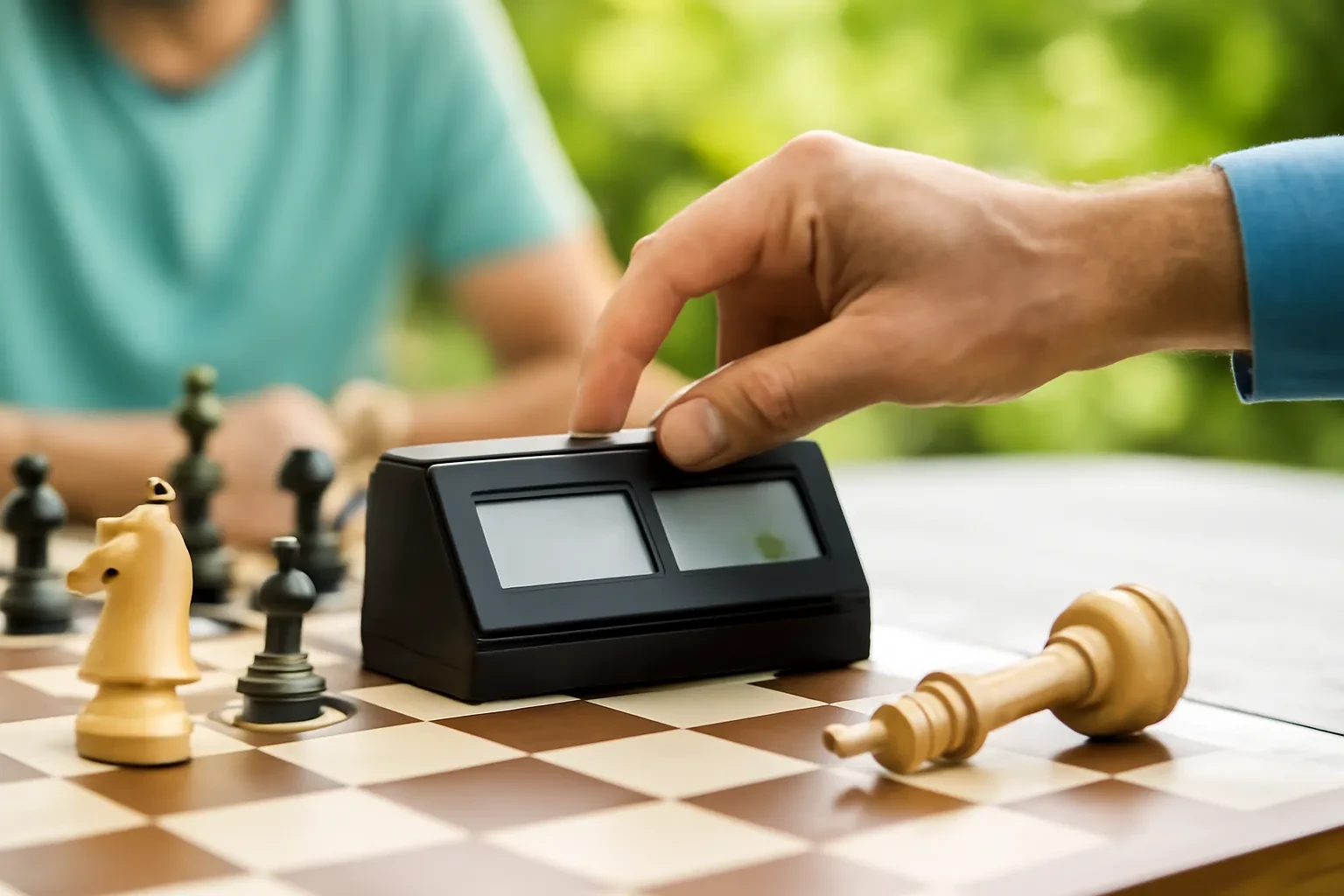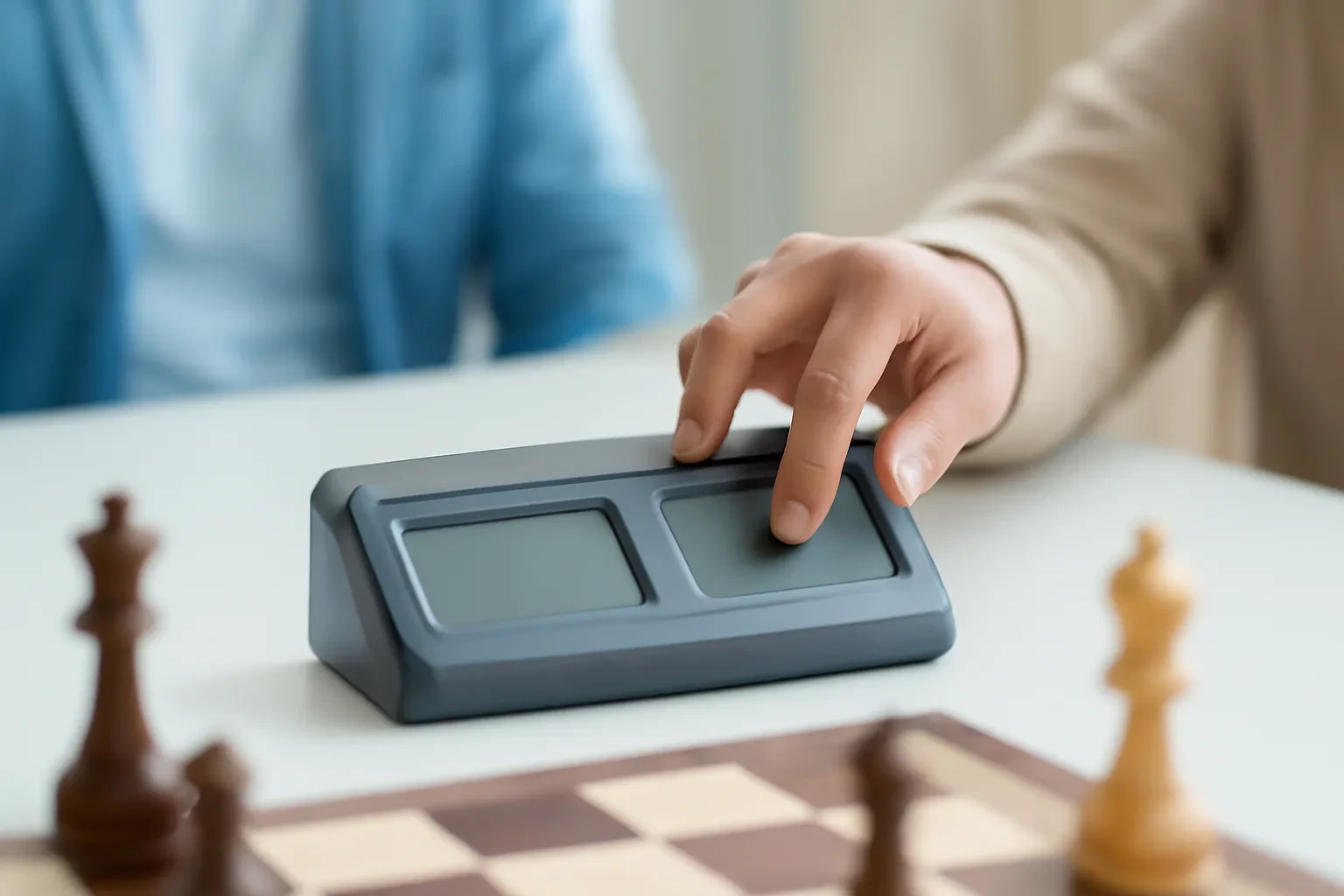
Two players open the same website and press "Play." One picks 1 minute, the other 15 minutes. They're playing the same game with the same rules — and yet they're practically playing different sports. At one minute, chess is a race of reflexes and mouse speed. At fifteen, it's a contest of thinking.
This guide explains time controls, how to read their notation, where the categories begin and end, and — most importantly — which one to choose if your goal is to get better rather than just to play more.
Reading the notation: A+B
Most time controls are written A+B:
- A is the number of minutes each player has for the whole game.
- B is the number of seconds added after every move (the increment).
So 3+2 means three minutes each, plus two seconds after each move. 10+0 means ten minutes, no increment: when it's gone, it's gone.
Increment changes more than it seems. Without it, the end of a game can become a pure speed contest: a player with a completely winning position and three seconds left can lose on time before delivering mate. With increment, as long as you move quickly, your clock never truly runs out — winning positions can actually be won.
The categories
The names are universal; the exact boundaries depend on who's counting.
| Category | Typical examples | Feel |
|---|---|---|
| Bullet | 1+0, 2+1 | Reflexes; almost no calculation |
| Blitz | 3+0, 3+2, 5+0, 5+3 | Fast; mostly intuition |
| Rapid | 10+0, 10+5, 15+10 | Time to calculate critical moments |
| Classical | 30+0 and slower; tournaments often 90 minutes | Deep calculation and planning |
Under FIDE rules, a game is blitz if each player's time plus 60 times the increment is 10 minutes or less; rapid if that total is over 10 and under 60 minutes; and classical from 60 minutes up. The "60 times the increment" part converts increments into an estimated total for a typical 60-move game: 3+2 counts like a 5-minute game.
Online, each site sets its own boundaries, so the same 8+0 game might count as blitz on one site and rapid on another. That's one reason ratings are kept separately per time control, and why comparing a blitz rating on one site with a rapid rating on another tells you little.
What each time control trains
Bullet: reflexes and patterns
At one or two minutes, there's no time to calculate. Every move comes from pattern recognition. Bullet reinforces reflexes — but it reinforces bad habits too: playing the first move that comes to mind, skipping threat checks, hoping the opponent flags.
Blitz: intuition with quick checks
Three to five minutes is the world's most popular format. Fast enough to be fun, slow enough to stop and calculate a short line at a key moment. Strong players use blitz to practice openings and middlegame intuition.
Rapid: where improving players improve fastest
At 10–15 minutes, you have time to do what every lesson teaches: check the opponent's threats, find your worst piece, calculate a tactic to the end. If you could only pick one time control for improvement, most coaches would pick this.
Classical: where calculation is learned
Games of 30 minutes or more force you to calculate deeply and evaluate carefully. They're tiring and you can't play many per day. But a classical game reviewed carefully is worth a lesson.
So which should you play?
It depends on your goal, but one principle holds: the slower the game, the more you learn from each one. You can only learn from decisions you actually had time to make.
A reasonable mix for an improving player:
- Most games: rapid, 10+5 or 15+10.
- Some: blitz, 3+2 or 5+3, for fun and opening practice.
- Occasionally: a 30-minute game, reviewed carefully afterwards.
- Sparingly: bullet — especially not right after a frustrating loss.
Complete beginners should start with no clock at all. Until the rules and the board feel natural, time pressure just causes panic and illegal-move attempts. Once games flow smoothly, move to 15+10 and work down from there.
Delay versus increment
Some clocks, especially in North American over-the-board events, use delay instead of increment. With a delay, the clock waits a few seconds before it starts counting down on each move; if you move within the delay, you lose no time — but unlike increment, you never gain time either. Online sites almost always use increment. When you enter a tournament, check the time control announcement so you know which you're getting.
Matching time control to your goal
Different goals point to different formats:
- "I want to improve steadily." Rapid (10+5 to 15+10) for most games, with careful reviews.
- "I want to test my openings." Blitz (3+2, 5+3) gets you many games in the same opening quickly — just review the ones that went wrong.
- "I want to prepare for over-the-board tournaments." Mix in classical games of 30 minutes or more, and practice writing your moves down.
- "I just want to have fun." Anything you enjoy — but notice if fast games leave you frustrated rather than entertained.
It's perfectly normal for your strength to differ between formats. Many players are noticeably stronger at rapid than blitz, or the reverse. Treat each rating as its own measurement.
Why increment beats a bigger base time
Choosing between 5+0 and 3+2, many players pick 5+0 because it "has more time." For an improving player, 3+2 is usually better: over a 40-move game the total time is similar, but the increment ensures endgames are decided by chess, not by hand speed. You learn to convert winning positions instead of learning to flag.
Try it
On ChessDigi you can play the computer with no clock, 3+2, 5+3 or 10+5 — all with increment. If you're learning, start with 10 minutes or no clock. When you consistently beat the Medium level, try 5 minutes and see whether your intuition keeps up. If running out of time is a regular problem, read time management tips.
Frequently asked questions
What does 3+2 mean in chess?
Each player has three minutes for the whole game, plus two seconds added after every move they make.
Does blitz make you a worse player?
Not by itself, but playing only blitz tends to keep you where you are. Blitz reinforces what you already know; learning new things needs time to think, which means slower games.
Do you always lose if your time runs out?
Usually. The exception: if your opponent doesn't have enough material to possibly checkmate you — only a king, or a king and a single knight or bishop — the game is drawn.
What time control do tournaments use?
Classical tournaments commonly use 90 minutes for 40 moves plus 30 minutes for the rest, with 30 seconds added per move from move one. Rapid events often use 15+10 or 25+10; blitz events often use 3+2.