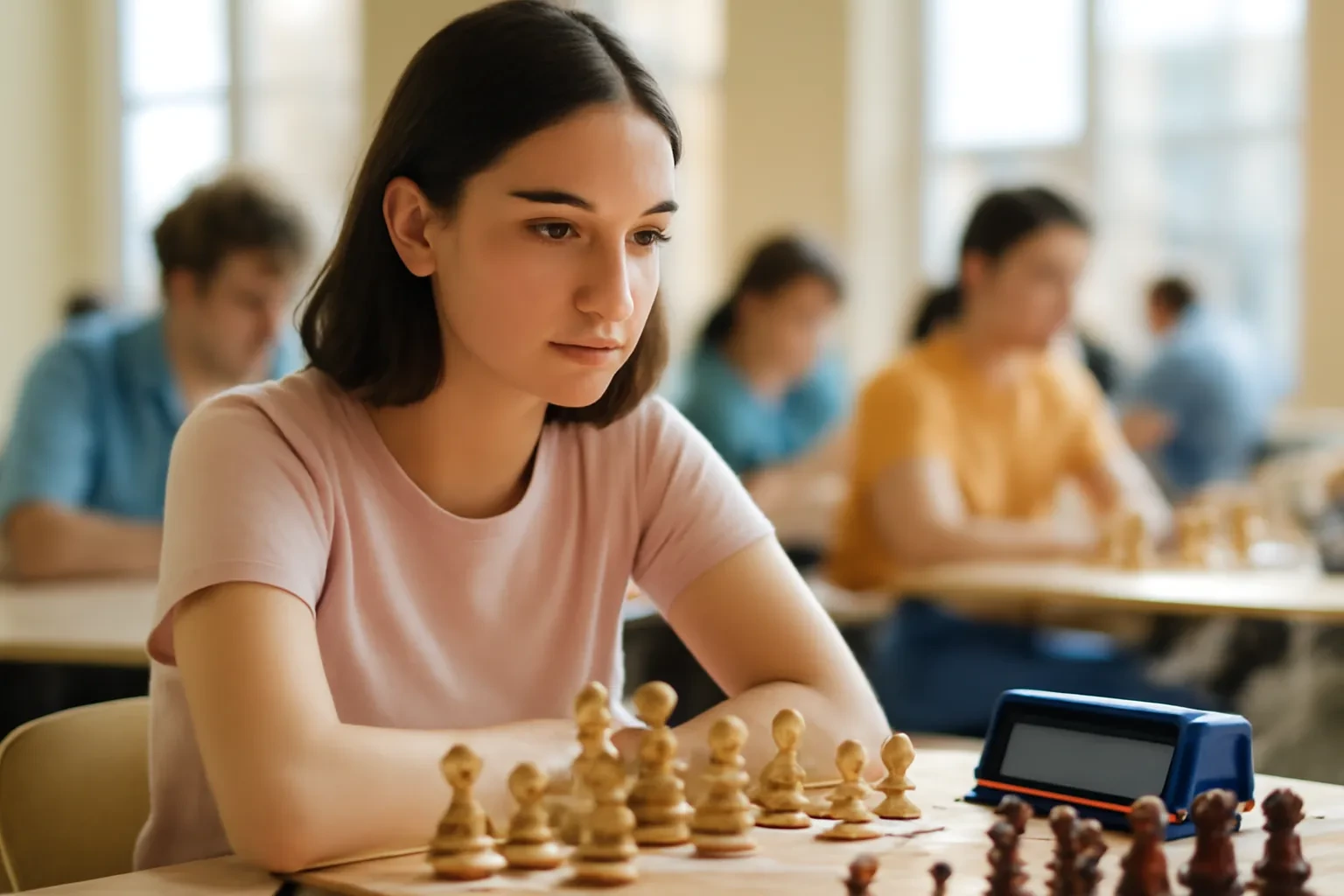
Ask club players how they lose games, and "I was winning but ran out of time" comes up again and again. Time trouble is not a separate problem from chess skill — it is a skill of its own, and it can be trained like any other. Most players who are chronically short of time are not slow thinkers. They spend their time in the wrong places.
This guide gives you a simple budget, a way to identify the moves that deserve your time, and a plan for the moments when the clock is almost gone.
Why players run out of time
The usual causes are predictable:
- Thinking hard about obvious moves — recaptures, forced replies, standard opening moves.
- Re-checking the same line three or four times because of anxiety rather than new information.
- Perfectionism in positions that don't need it, like looking for the best of five equally good moves.
- Spending the opponent's time idly instead of thinking while they move.
Notice that none of these are about calculating too slowly. They are about not deciding when a decision was already available.
A simple budget
A useful way to think about the clock is to split your time by game phase. For a typical game of around 40 moves:
| Phase | Share of your time | What you're doing |
|---|---|---|
| Opening (moves 1–10) | about 10% | Known moves, fast |
| Middlegame (moves 11–30) | about 60% | Plans, tactics, critical decisions |
| Endgame / conversion | about 30% | Calculation, precision |
In a 10-minute game, that means spending roughly one minute on the first ten moves. If you are at move 10 with seven minutes left, you are already behind schedule.
Another rule of thumb is to never spend more than about 10% of your remaining time on one move unless it is genuinely critical. With five minutes left, that is thirty seconds. It forces you to decide.
Where to spend your time: critical moments
Not all moves are equal. Most games have three to five critical moments where the outcome is really decided. Recognizing them is the most important time-management skill. Typical signs:
- Captures and recaptures with a choice — which piece to recapture with often changes the structure permanently.
- Pawn breaks and pawn pushes — they can't be undone.
- The moment the position opens — when pawns are exchanged in the center or near a king.
- The transition to an endgame — trading into an ending is irreversible, so it is worth checking that the ending is good.
- When your opponent's last move surprised you — a surprise means your understanding of the position was incomplete.
When you recognize one of these, spend real time. Everywhere else, play the natural move quickly.
Use your opponent's time
While your opponent thinks, you have free time too. Use it to:
- Look for their threats — what are they likely to play?
- Prepare your answer to their most likely moves, so you can reply instantly.
- Think about your plan, not just the next move.
This is the most efficient "extra" time you'll ever get. Many strong players make their most important decisions during the opponent's clock.
Increment changes everything
If your game has an increment — like 3+2 or 10+5 — every move gives you a few seconds back. That changes the math:
- In 3+2, if you play the easy moves in under two seconds each, your clock actually goes up.
- In 10+5, time trouble is much less deadly, because you can never be flagged if you move within five seconds.
With increment, learning to play obvious moves fast is doubly valuable: you save time and bank the increment. Without increment, the endgame can turn into a pure speed contest — which is why many players prefer increment formats for serious games.
When you're low on time
Eventually you will be down to your last minute. Some principles for that phase:
Switch from "best" to "safe". With little time, you are not looking for the best move anymore. You are looking for a move that doesn't lose. Keep pieces protected, avoid pawn moves near your king, and prefer simple positions.
Simplify when ahead. Trading pieces reduces the number of things that can go wrong. If you are up material, trade down.
Keep it complicated when behind. If you are losing and your opponent is also short of time, the reverse applies — keep tension and threats on the board.
Don't premove recklessly. Premoving (setting your move in advance online) saves time but can hang pieces. Only premove when the reply is truly forced, like a recapture.
Check the opponent's clock. If they are even lower than you, sometimes the right decision is simply to play solid moves quickly and let their clock do the work.
How to train it
Time management improves fastest with deliberate practice:
- Play slower games and watch the clock. In 15+10 games, check your remaining time at move 10, 20 and 30. Compare with the budget above.
- Review where your time went. Many game histories show the time spent per move. Find the three moves where you used the most time. Were they critical moments, or did you hesitate on something obvious?
- Practice fast decisions on easy moves. Some players do short "blitz only on obvious recaptures" drills: every time a move is forced, play it in under two seconds.
Try it
On ChessDigi you can play the computer with 3+2, 5+3 or 10+5 — all with increment. Pick 10+5, use the budget above, and see if you reach move 30 with at least a third of your time left. Then read about the differences between bullet, blitz, rapid and classical to choose the format that suits your goals.
Frequently asked questions
How much time should I spend in the opening?
About 10% of your total time for the first ten moves in most games. If you know the opening well, less. Spending a quarter of your clock in the opening almost always leads to time trouble later.
Is it better to play fast or slow?
Neither — the goal is to play easy moves fast and critical moves slow. Players who play everything at the same speed either blunder in critical moments or run out of time.
What should I do with 30 seconds left?
Play safe, simple moves quickly. Keep your pieces protected, avoid weakening your king, and simplify if you are ahead. Stop searching for brilliant moves.
Does increment really make a difference?
Yes. Even two seconds per move means you can never run out of time if you keep moving quickly, which keeps won positions winnable. It also rewards playing obvious moves fast.