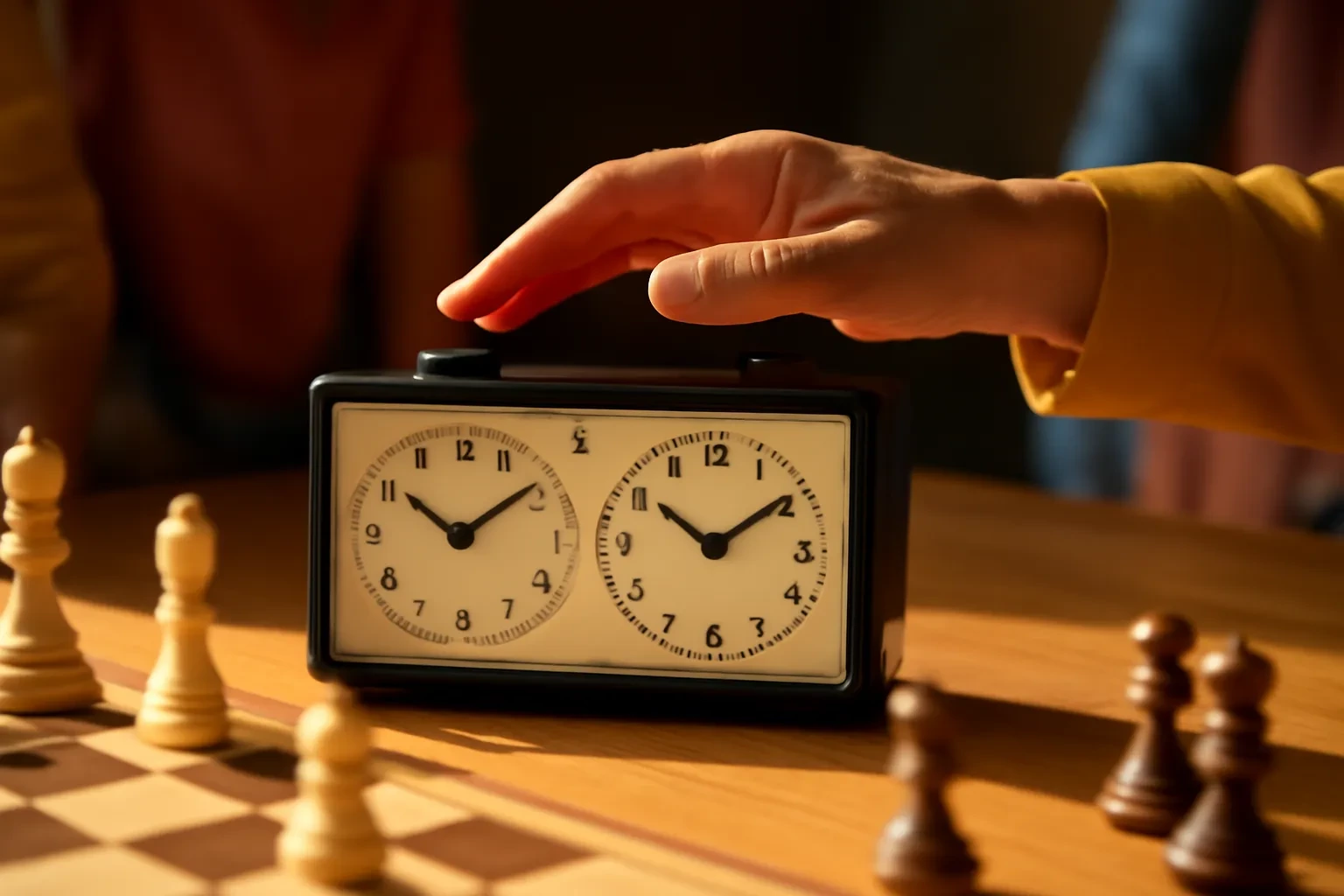
Every online chess site offers a menu of time controls: one minute, three minutes, ten, fifteen, thirty, even days per move. Most players pick whatever feels fun. But if your goal is improvement, the time control you choose matters a lot, because it shapes what kind of thinking you practice.
This article explains why slower games teach more, suggests time controls by level, explains why increment helps, and shows how to mix faster and slower games without stalling your progress. For an overview of formats, see bullet, blitz, rapid, and classical.
Why slower games teach more
- Time to apply what you learn. You studied pins yesterday; in a three-minute game you won't have time to look for one. In a fifteen-minute game, you will.
- Time to check threats. The most important habit, asking what your opponent threatens and what's undefended, needs a few seconds every move.
- Better games to review. Blitz games are full of rushed moves. Slow games reflect how you actually think, so reviewing them teaches more.
- Less about mouse speed. In very fast games, the faster clicker often wins, not the better player.
Suggested time controls by level
| Level | Suggested format | Why |
|---|---|---|
| Just learned the rules | Untimed games against the engine | Learn without pressure |
| First few months | 15+10 (15 minutes + 10 seconds per move) | Time to think, builds habits |
| Comfortable, avoiding basic blunders | 10+5 to 15+10, plus some longer games | Balance of thinking and practice |
| Preparing for tournaments | Similar to your tournament format, e.g. 30+ minutes | Practice the real conditions |
| For fun | 3+2 or 5+3 | Enjoyable, but not the main training |
Why increment helps
Increment adds a few seconds to your clock after every move. It means you can't lose a winning position just because you ran out of time in a scramble. It also rewards good moves over fast clicking. For improvement, prefer formats with increment. See what is increment.
Daily (correspondence) chess
Some sites offer games where each move can take a day or more. Daily chess is excellent for:
- Deep thinking: you can calculate carefully and check every idea.
- Busy schedules: make a move whenever you have a quiet minute.
- Learning openings: many sites allow looking up openings in daily games. Check the rules first.
It doesn't train speed or practical decision-making, so mix it with live games.
How to use your time in a slow game
Having more time doesn't mean using it evenly:
- Opening: move fairly quickly using principles. Don't spend five minutes on move three.
- Middlegame: spend the most time at critical moments, such as when pieces are attacked, when trades are possible, or after a surprising move.
- Endgame: calculate precisely, but keep a reserve.
See time management tips.
Mixing speeds
You don't have to give up fast games. A balanced week might look like:
- Three slow games, each reviewed.
- Tactics most days, about fifteen minutes.
- A few blitz games for fun or opening practice.
- One endgame session.
The principle: slow games to learn, fast games to practice and enjoy. See should you play blitz.
Signs your time control is too fast
- You often lose on time or play your last moves with seconds left.
- You make blunders you'd never make with more time.
- You can't remember why you played most of your moves.
- Your rating in fast games moves but your understanding doesn't.
If this sounds familiar, slow down for a few weeks and see how your play changes.
Signs you're ready for faster games
- You rarely blunder pieces in slow games.
- You recognize common tactics quickly.
- You want to practice opening lines through repetition.
Even then, keep some slow games in your routine.
Common mistakes
Only playing bullet or blitz. Fun, but hard to learn from.
Never playing with a clock. If you plan to play tournaments, get used to one.
Playing slow games without reviewing them. Loses most of their value.
Using all your time in the opening. Leads to time trouble later.
What a good slow game looks like
A slow game is only valuable if you use the extra time well. A productive 15+10 game usually has these features:
- You spend the first few moves quickly, following opening principles or your prepared line.
- You slow down at key moments: when your opponent makes a threat, when you consider a trade, or when the position changes character.
- You run a blunder check before most moves, even when you feel sure.
- You finish with some time left, rather than scrambling in the last minute.
- You review it afterward, even briefly.
If your slow games don't look like this, the time control alone won't help. The point is not the clock, but the thinking the clock allows.
Practical tips for online slow games
- Pick a quiet time when you won't be interrupted for 30–40 minutes.
- Close other tabs and silence notifications.
- Sit at a proper desk if possible; a phone on the sofa invites rushed moves. See chess on mobile.
- Don't start a slow game if you're already tired. Play a few puzzles instead.
A simple experiment
If you're not convinced that slower games help, try this: for four weeks, play only 15+10 or slower games, reviewing each one. Then compare your games from before and after. Most players notice fewer blunders, clearer plans, and more confidence, even when they return to faster formats.
Frequently asked questions
What is the best time control to improve?
For most improving players, rapid games with increment, around 15+10, offer the best balance of thinking time and practice.
Should beginners play blitz?
A little for fun, but most beginner games should be slower.
Is daily chess good for improvement?
It's good for deep thinking and calculation, but mix it with live games for practical skills.
Why does increment matter?
It prevents losing won positions purely on time and rewards good moves over fast clicking.
How many slow games should I play per week?
Three or more reviewed slow games per week is a solid base for most players. More time control guides are in the time control section.
Can I improve by playing only blitz?
Some players do, but it is usually slower and less reliable. Blitz trains intuition and speed, while slow games and puzzles build calculation and good habits. Most improving players get better results by making slow games the core of their training and treating blitz as a supplement. Over a few months, that core of slow, reviewed games is what turns knowledge into reliable skill.